


Kranj’s Smart Solutions Presented in Warsaw, Tallinn and London
In March, the Municipality of Kranj received invitations to two major international events – the Data Spaces Symposium in Warsaw and the Smart City Exchange Forum in Tallinn. Meanwhile, at the world’s largest event for innovations in public transport in London, the city card CeKR was shortlisted as a finalist.
The Data Spaces Symposium 2025 took place in the Polish capital in early March. The two-day event brought together more than 800 experts, decision-makers, and industry leaders from over 40 countries. Organized by the Data Spaces Support Centre (DSSC) and the Data Spaces Business Alliance (DSBA), the symposium focused on the future of the data economy – in particular, how to ensure sovereign, interoperable, and trustworthy data sharing, which is essential for successful business transformation.
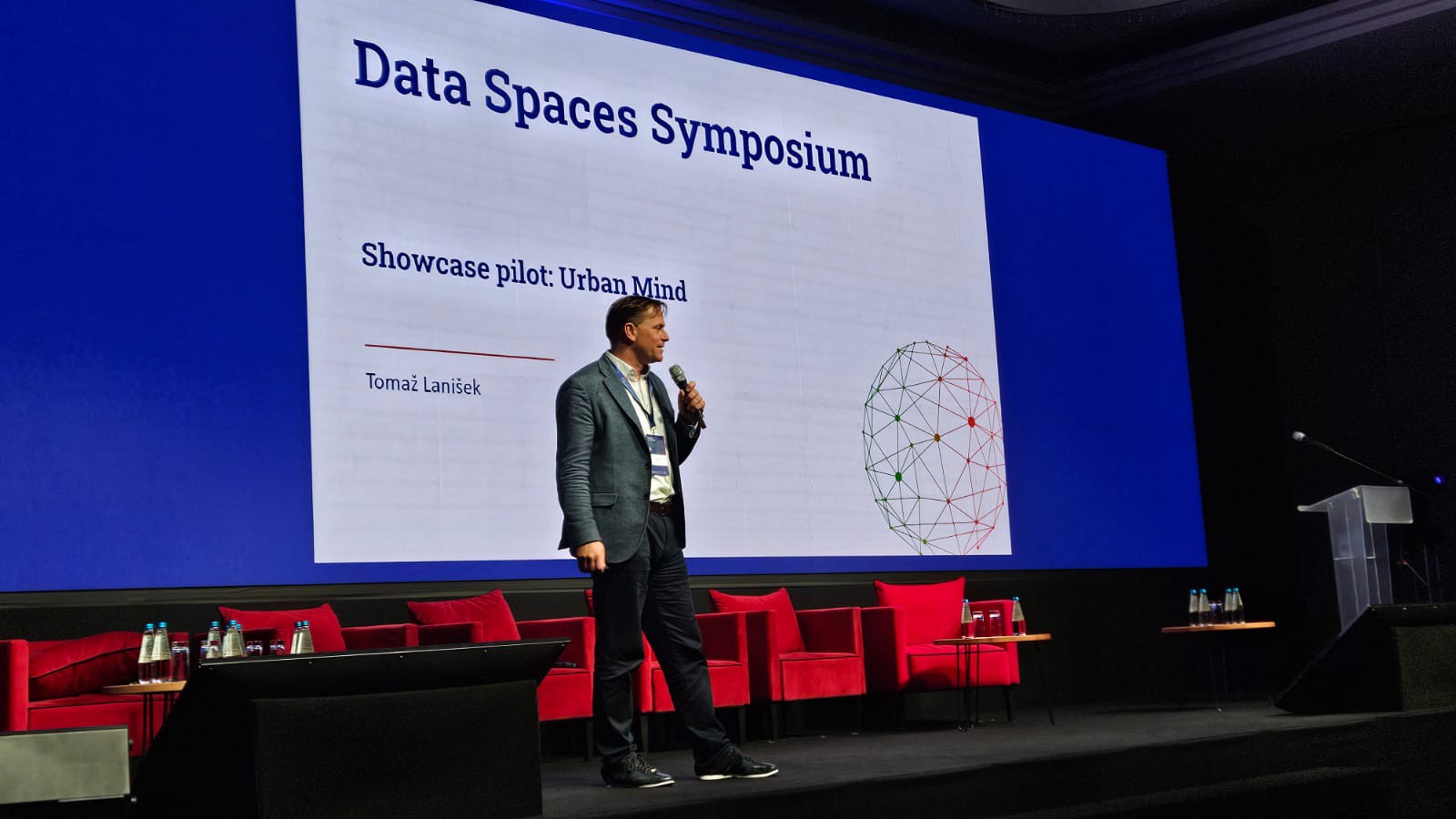
One of the key panel discussions on the main stage explored the concept of a European Data Space for Smart Communities. Among the distinguished speakers was Tomaž Lanišek, Head of the Office for Development and Smart Community of the Municipality of Kranj. He presented the pilot project UrbanMind, which Kranj, together with the City of Pula and companies Riko and 3fs, successfully submitted last year to the Digital Europe Programme (European Data Space for Smart Communities – DS4SSCC-DEP).
In Kranj, the project aims to develop a data collection system for traffic flows, with a particular focus on the historic city centre, which is heavily burdened by traffic. Sensors will be installed at various locations and on buses to monitor vehicle movements, speed, as well as the number of pedestrians and cyclists. The system will then be upgraded with AI-powered traffic flow prediction, enabling simulation and optimization of mobility while also providing the basis for introducing pedestrian zones.
In Kranj, the project aims to develop a data collection system for traffic flows, with a particular focus on the historic city centre, which is heavily burdened by traffic. Sensors will be installed at various locations and on buses to monitor vehicle movements, speed, as well as the number of pedestrians and cyclists. The system will then be upgraded with AI-powered traffic flow prediction, enabling simulation and optimization of mobility while also providing the basis for introducing pedestrian zones.
Shaping Cities with Data, Artificial Intelligence and Smart Governance
After the event in Warsaw, Tomaž Lanišek attended the Smart City Exchange Forum 2025 in Tallinn, Estonia. The organizers invited the representative of the Municipality of Kranj primarily to showcase projects such as Smart Mlaka, UrbanMind, the city’s digital platform, and the CeKR city card.
The forum brought together numerous city leaders, researchers, and technology experts. A central theme across many discussions was how data, artificial intelligence, and smart governance can transform urban environments, and how legislation can foster innovation.
Lanišek contributed to the panel discussion “Regulatory Sandboxes and the Real World – Is a Win-Win Model Possible?”. Panelists – leading experts in public policy, innovation, and digital transformation (Tallinn University of Technology, Accelerate Estonia, Digital Nation, and others) – explored how regulatory sandboxes, effective governance, and stakeholder engagement can help reconcile conflicting interests, and what benefits such approaches could bring to cities and countries alike.

